
Patent Literacy Discussed at BEUN Science Café: The Journey from Idea to Invention
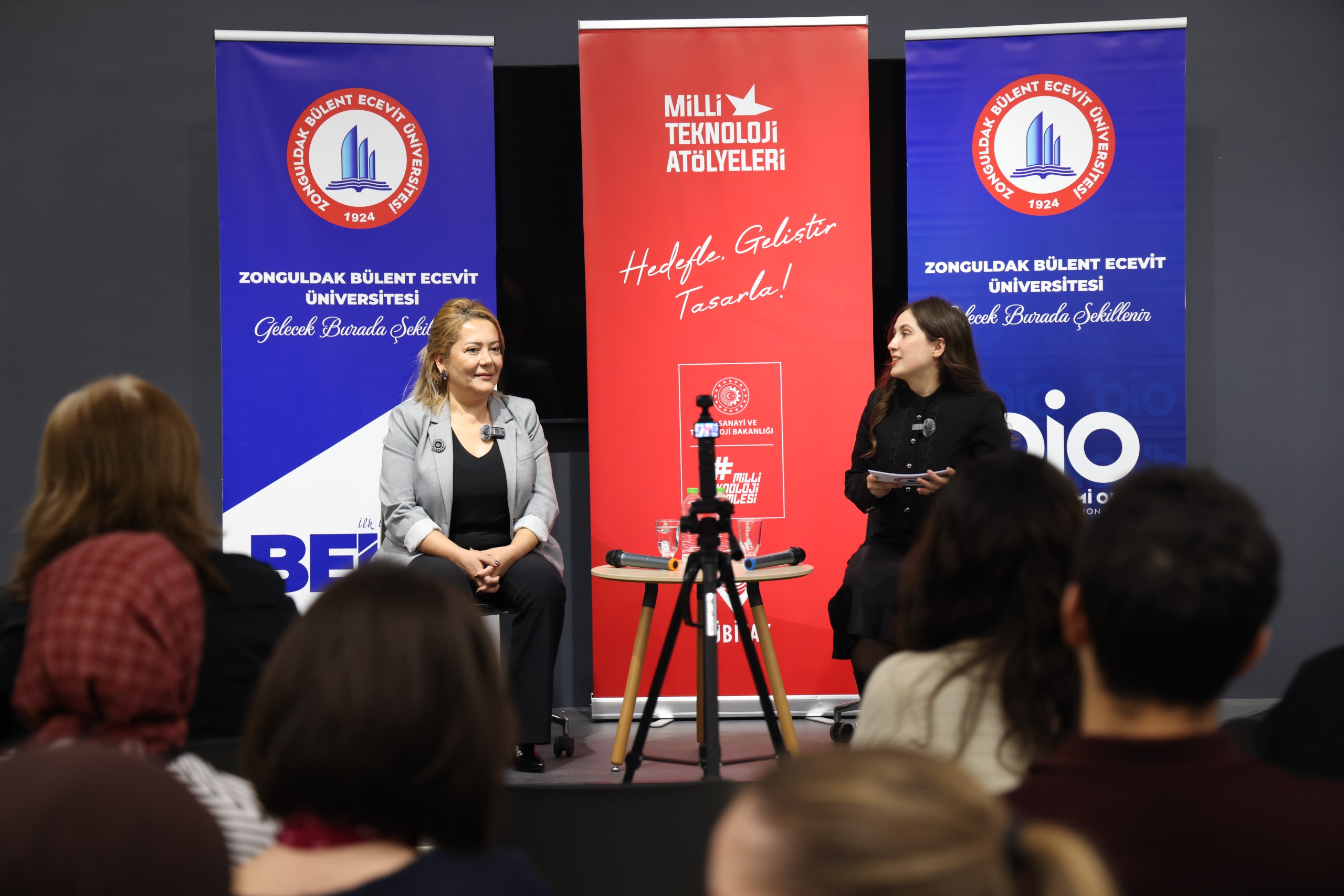
Zonguldak Bülent Ecevit University (BEUN) continues to hold “Science Café” events, which bring its academic knowledge and expertise together with society and aim to raise scientific awareness. As part of the Science Communication Office events established under the leadership of the Council of Higher Education (YÖK), a talk titled “Patent Literacy: From Idea to Invention – Protecting Innovation and Turning It into Value” was held at the National Technology Workshop. The talk addressed the process of turning ideas into inventions, patents and intellectual property rights, and legal ways of protecting innovative projects.
Moderated by BEUN Science Communication Office Coordinator Lecturer Yağmur Atalay, the event featured Prof. Dr. Şenay Saraç, Coordinator of the BEUN TÜRKPATENT Industrial Property Consultancy Unit, as the speaker. The talk attracted particular interest from young people, students and aspiring entrepreneurs developing projects in the field of technology. A wide range of topics was discussed in detail, from the conditions under which an idea can be patented and application procedures to the support provided by universities to inventors and international patent protection.
“Not Every Idea Is Patentable: An Invention Must Have an Innovative Aspect”
In the first part of the talk, Prof. Dr. Şenay Saraç discussed the scope of intellectual property rights and stated that these rights are considered under two main categories: copyright and industrial property rights. Saraç explained that books, scientific and artistic works, and computer software are protected under copyright, while patents, utility models, trademarks, designs and geographical indications fall within the scope of industrial property rights.
Drawing attention to the importance of the patent system in research and development (R&D) and innovation processes, Prof. Dr. Saraç emphasised that a patent grants the inventor an exclusive legal right for a specified period. She stated that the main purpose of this system is to encourage technological innovation, safeguard inventors’ rights and contribute to the development of new technologies.
Underlining that not every new idea can be protected by a patent, Saraç explained that an invention must meet the criteria of novelty, inventive step and industrial applicability to be granted a patent. Giving examples from everyday life, she noted that a simple modification to an ordinary partition design would not, on its own, be patentable. However, a unique product that offers a solution to a technical problem and can be applied in industry may qualify for patent protection.
Can Software Projects Be Patented? “They Must Offer a Technical Solution”
The patentability of software, a topic of particular interest to young people developing projects in software and technology, was also discussed during the talk.
Stating that software cannot always benefit from patent protection on its own, Prof. Dr. Saraç explained that it must contain a technical element and offer a solution to a technical problem. Referring to the importance of assessing software together with a device or technical system, Saraç gave examples of technological solutions such as braking systems used in cars and explained that the relationship between software and technical inventions plays a decisive role in patent assessment.
Saraç also discussed the duration of patent and utility model protection, stating that patent protection lasts for 20 years from the filing date, while utility model protection lasts for 10 years.
Patent Support for Young Inventors from the University
Responding to a question about who owns the patent rights when a project is developed by more than one person, Prof. Dr. Saraç explained that all individuals who contribute to an invention can be named as inventors and that their respective contributions can be determined during the application process.
Emphasising the opportunities available for projects developed within the University, Saraç stated that students and staff can apply to the University's Industrial Property Consultancy Unit in person or through its website and complete the required forms.
Drawing attention to the support provided by universities to inventors, Saraç stated that the University covers the costs of patent application and registration processes for inventions developed by its students and staff. In this context, she explained that the University is listed as the applicant, while the individuals who develop the project are named as the inventors. She emphasised that young people can receive support from the University's relevant units to protect their innovative ideas.
Is a Patent Obtained in Türkiye Also Valid Abroad?
Another topic that attracted participants' interest was the international validity of patents. Answering a question about what should be done if an invention patented in Türkiye is manufactured without permission in another country and used for commercial gain, Prof. Dr. Saraç emphasised that patent protection is national in scope.
Stating that a patent obtained in Türkiye does not automatically provide protection anywhere else in the world, Saraç explained that inventors must also complete the relevant application procedures in the countries where they wish to protect their rights. Referring to the importance of international patent applications and protection mechanisms, Saraç noted that inventors should carefully consider national and international application procedures according to their target markets.
From Idea to Invention, from Invention to Added Value
The talk, which highlighted the importance of patent literacy in helping young people protect their innovative ideas, contribute to technological developments and turn their projects into economic value, concluded with a question-and-answer session.